An eight-week crossover trial reveals how a daily serving of walnuts affects mood alongside measurable shifts in serotonin-related and gut-derived metabolites.
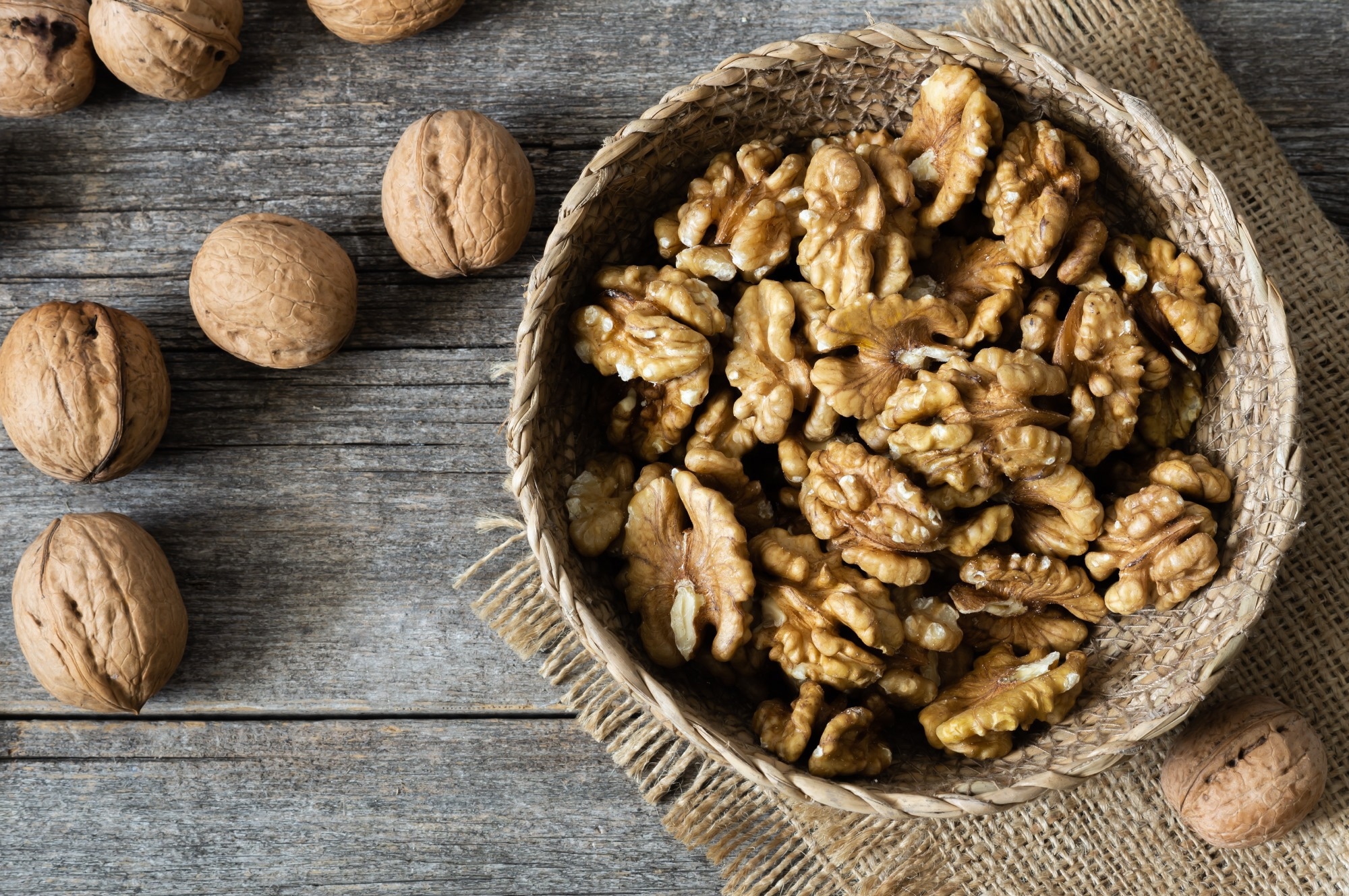 Study: Walnut consumption improves mood and is associated with increased urinary excretion of 5-hydroxyindoleacetic acid and urolithins in a randomized crossover trial. Image Credit: Halil ibrahim mescioglu / Shutterstock.com
In a recent study published in Food & Function, researchers evaluated whether 8 weeks of walnut consumption affects mood states in young adults and whether these effects are associated with urinary 5-hydroxyindoleacetic acid (5-HIAA), cortisol, and urolithin levels.
Why walnuts may influence mood
Mental health disorders affect 13.9% of the global population, with the burden expected to rise among young people. Diet has emerged as a lifestyle factor relevant to mental health due to the brain's high energy and nutrient requirements.
Serotonin is a neurotransmitter involved in mood regulation and is produced from the dietary amino acid tryptophan. Its main metabolite, 5-HIAA, can be measured in urine as an indicator of serotonin metabolism. Walnuts are rich in omega-3 fatty acids, tryptophan, fiber, and polyphenols, including ellagitannins that gut microbiota convert into urolithins. These metabolites may indicate walnut intake and biological responses; however, further research is needed to clarify how walnut consumption relates to mood and metabolic pathways.
Putting daily walnut consumption to the test
The study used an 18-week open-label randomized crossover trial involving adults aged 20–35 years. Researchers recruited participants from December 2021 to February 2022.
To be eligible, candidates had to have a body mass index (BMI) of 19 to 26 kg/m² and maintain moderate physical activity. Exclusion criteria included nut allergies, acute or chronic illnesses, smoking, use of drugs or dietary supplements, restrictive diets, shift work, and inability to provide written informed consent. Of 84 screened individuals, 36 were enrolled; 5 withdrew, leaving 31 participants who completed both arms. The University of Barcelona Ethics Committee approved the study, and it was registered at ClinicalTrials.gov.
Participants were randomly assigned to consume 40 g of walnuts per day with dinner or to refrain from nuts and nut products for the next 8 weeks. After a 2-week washout period, participants crossed over to the alternate condition.
A nutritionist provided standardized guidance for participants to follow a Mediterranean-style diet in both conditions. Mood was assessed with the Profile of Mood States Questionnaire (POMS), whereas perceived stress, well-being, and trait food cravings were assessed with validated Spanish questionnaires.
First-morning urine samples were obtained for 5-HIAA and cortisol analysis using enzyme-linked immunosorbent assay (ELISA), normalized to creatinine, and for urolithins using high-performance liquid chromatography coupled to quadrupole time-of-flight mass spectrometry (HPLC-QTOF-MS). Linear mixed-effects models and repeated-measures correlations were used throughout. d6fo00807k
Walnut consumption reduced total mood disturbance
The 31 participants had a mean age of 24 years, 90.3% of whom were women. At baseline, mean BMI was 21.6 kg/m² and body fat percentage was 25.7%.
During the walnut condition, total mood disturbance was 4.85 points lower than during the control condition. Anger and fatigue also decreased, but these differences did not remain statistically significant after correction for multiple comparisons. No significant differences occurred for friendliness, vigor, perceived stress, or well-being.
Two trait food-craving domains showed initial reductions: anticipation of relief from negative states and feelings after eating and guilt associated with cravings or giving in to them. However, neither finding remained statistically significant after multiple-testing correction. In repeated-measures analyses, higher scores in both domains were associated with increases in anger, fatigue, or total mood disturbance.
Urinary 5-HIAA increased significantly during walnut consumption, while urinary cortisol did not differ significantly between conditions. Higher urinary 5-HIAA was associated with lower total mood disturbance. The paper also reports an association with lower fatigue, although the reported significance is internally inconsistent. Higher urinary 5-HIAA was not associated with the assessed food-craving domains.
Urinary urolithin A and urolithin B concentrations were also significantly higher during walnut consumption, and increases in both metabolites were associated with concurrent increases in urinary 5-HIAA. BMI, body fat percentage, and physical activity did not differ significantly. Diet quality was modestly but significantly higher during the walnut condition than during the control condition.
Urinary 5-HIAA reflects whole-body serotonin metabolism and can be influenced by peripheral serotonin production, diet, intestinal metabolism, and renal excretion. The current study did not measure brain serotonin or central serotonergic function; therefore, these observed associations cannot establish a mechanism linking walnuts with changes in brain serotonin activity.
The small sample, predominance of women, and open-label design also limit interpretation, as they may have introduced expectancy bias. Researchers did not conduct another assessment immediately before the second intervention period, so they could not directly confirm that participants had returned to comparable physiological and behavioral states after the washout.
Participants also avoided all nuts during the control condition, which may have differed from their usual diets. The young study population also limits how readily the findings apply to other groups.
What the findings mean for mood and serotonin metabolism
The randomized crossover trial found that consuming 40 g of walnuts daily for 8 weeks was associated with lower total mood disturbance and higher urinary 5-HIAA in healthy young adults. Urinary urolithin A and B also increased and were correlated with concurrent changes in urinary 5-HIAA.
The study found no significant differences in urinary cortisol levels, perceived stress levels, well-being, or positive mood. Together, these findings suggest a potential association between walnut-derived microbial metabolites and whole-body serotonin metabolism, but the underlying pathways remain uncertain. Further research with larger, more diverse populations and longer intervention periods is needed.
Journal reference:
- Zerón-Rugerio, M. F., Parilli-Moser, I., Gonzalez-Rodriguez, A., Urpi-Sarda, M., Diez-Hernández, M., Ibarra-Picón, A., Barrau-Martinez, B., Pérez-Cano, F. J., Cambras, T., & Izquierdo-Pulido, M. (2026). Walnut consumption improves mood and is associated with increased urinary excretion of 5-hydroxyindoleacetic acid and urolithins in a randomized crossover trial. Food & Function. DOI: 10.1039/d6fo00807k. https://pubs.rsc.org/fo/article/doi/10.1039/d6fo00807k/1362774/Walnut-consumption-improves-mood-and-is-associated
 Exercise may reshape your gut microbiome to support recovery